
Tacoma, WA
Stop on the proposed 17,000-mile maglev network. Next stop: Kent, WA (13.2 mi).
About Tacoma
Tacoma is a city in and the county seat of Pierce County, Washington, United States. A port city, it is situated along Puget Sound roughly 30 miles (48 km) from Seattle and Olympia, and 58 miles (93 km) northwest of Mount Rainier National Park. Tacoma is the second-largest city in the Puget Sound area and the third-most populous city in the state with a population of 219,346 at the 2020 census.
Source: Wikipedia summary (full article). Population and facts as published there.
Cost breakdown (proposal-scale estimates — see math)
| Item | Basis | Estimate |
|---|---|---|
| Terminal construction | Large-city terminal ($2–4B range) | $3.0B |
| Land acquisition | Regional factor 1.5× on $200M base | $300M |
| Track: Tacoma → Kent | 13.2 mi × $500M/mi | $6.6B |
| Annual operations (share) | 2% of $3.0B terminal | $60M/yr |
| Stop total (excl. annual ops) | $9.9B |
Best terminal location (proposed)
The Tacoma Dome Station district. Tacoma Dome Station is the South Sound's intermodal hub — Sounder commuter rail, Amtrak Cascades, the T Line, and express buses all converge. The dome district's parking lots and industrial edges give a large buildable footprint. The catchment is the South Sound's 900,000+ residents plus the Port of Tacoma workforce, with I-5 commutes among the worst in the state.
Before / after
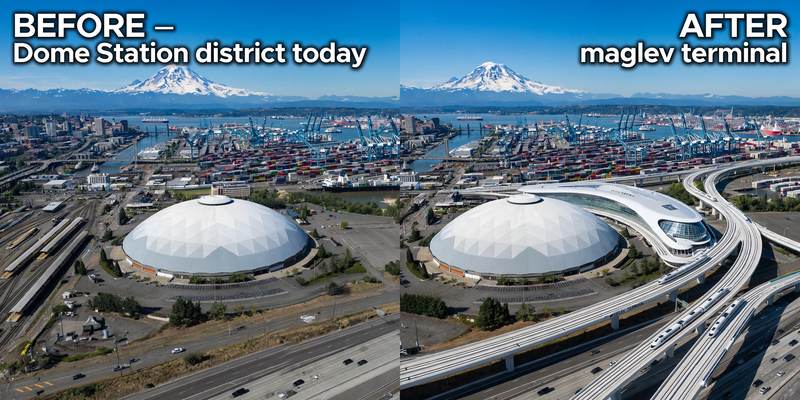
Aerial mock-up (illustrative, not an engineering rendering). Left: the proposed site today. Right: with the maglev terminal.
- Fife — port-adjacent small city on the Puyallup flats.
- Federal Way — suburban retail and residential city on the corridor.
- Southcenter district — Tukwila retail and employment hub.