
Tampa, FL
Stop on the proposed 17,000-mile maglev network. Next stop: St. Petersburg, FL (16.6 mi).
About Tampa
Tampa is a major city on the Gulf Coast of the U.S. state of Florida and the county seat of Hillsborough County. Tampa's borders include the north shore of Tampa Bay and the east shore of Old Tampa Bay. It is the third-most-populous city in Florida, 13th-most-populous in the Southeast, and 49th-most-populous city in the country, with a population of 403,364 at the 2020 census.
Source: Wikipedia summary (full article). Population and facts as published there.
Cost breakdown (proposal-scale estimates — see math)
| Item | Basis | Estimate |
|---|---|---|
| Terminal construction | Large city — metro tier (range $2–4B) | $3B |
| Land acquisition | Regional factor 1.5× on $200M base | $300M |
| Track: Tampa → St. Petersburg | 16.6 mi × $500M/mi | $8.3B |
| Annual operations (share) | Staffing, power, maintenance | $60M/yr |
| Stop total (excl. annual ops) | $11.6B |
Best terminal location (proposed)
The Union Station / Ybor Channel District corridor. Tampa Union Station already serves Amtrak on a historic rail corridor east of downtown, with freight rights-of-way that could carry elevated guideways. The Channel District's redevelopment and the Ybor streetcar connection would feed cruise-ship and airport travelers into the terminal, serving both sides of the bay.
Before / after
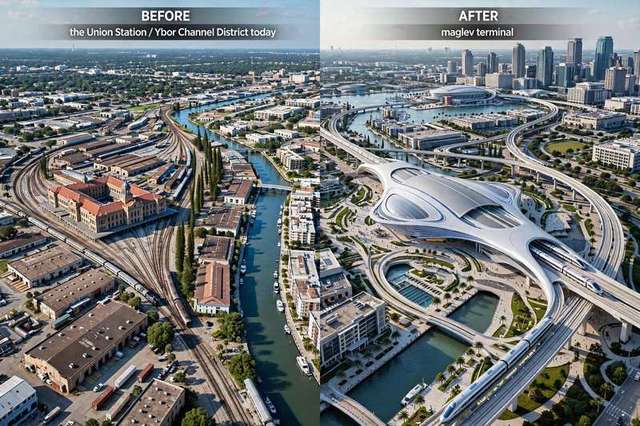
Aerial mock-up (illustrative, not an engineering rendering). Left: the proposed site today. Right: with the maglev terminal.
- Rocky Point (Tampa) — causeway community on the Tampa side of the bay.
- Feather Sound (Pinellas) — business district mid-causeway.
- The Gateway area (St. Petersburg) — employment hub near the airport.