
Tucson, AZ
Stop on the proposed 17,000-mile maglev network. Next stop: Chandler, AZ (91.9 mi).
About Tucson
Tucson is the county seat of and the most populated city in Pima County, Arizona, United States. It is the second-most populous city in Arizona with a population of 542,630 at the 2020 census, behind the capital city, Phoenix, while the Tucson metropolitan statistical area has an estimated 1.08 million residents and is the 52nd-largest metropolitan area in the United States. Tucson and Phoenix anchor the Arizona Sun Corridor.
Source: Wikipedia summary (full article). Population and facts as published there.
Cost breakdown (proposal-scale estimates — see math)
| Item | Basis | Estimate |
|---|---|---|
| Terminal construction | Large-city terminal (parametric range $2–4B) | $3B |
| Land acquisition | Regional factor 1.0× on $200M base | $200M |
| Track: Tucson → Chandler | 91.9 mi × $500M/mi | $46.0B |
| Annual operations (share) | Staffing, power, maintenance | $60M/yr |
| Stop total (excl. annual ops) | $49.2B |
Best terminal location (proposed)
The Ronstadt Transit Center district downtown. Ronstadt is the Sun Tran system's central hub, served by the Sun Link streetcar, and sits two blocks from the historic Southern Pacific depot and Amtrak. Downtown Tucson's warehouse district offers infill parcels, and the site captures both the university and the metro's south-side growth.
Before / after
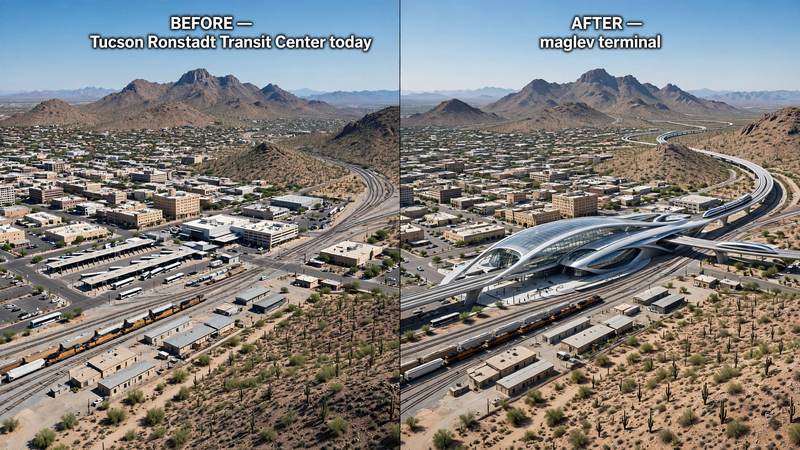
Aerial mock-up (illustrative, not an engineering rendering). Left: the proposed site today. Right: with the maglev terminal.
- Marana, AZ — northwest suburb on the I-10 corridor.
- Casa Grande, AZ — Pinal County hub midway between Tucson and Phoenix.
- Eloy, AZ — small city on the I-10 corridor.