
Tulsa, OK
Stop on the proposed 17,000-mile maglev network. Next stop: Broken Arrow, OK (13.4 mi).
About Tulsa
Tulsa is the second-most-populous city in the U.S. state of Oklahoma and the 48th-most populous city in the United States. The population was about 419K as of the 2026 census.
Source: Wikipedia summary (full article). Population and facts as published there.
Cost breakdown (proposal-scale estimates — see math)
| Item | Basis | Estimate |
|---|---|---|
| Terminal construction | Large-city terminal (parametric range $2–4B) | $3B |
| Land acquisition | Regional factor 1.0× on $200M base | $200M |
| Track: Tulsa → Broken Arrow | 13.4 mi × $500M/mi | $6.7B |
| Annual operations (share) | Staffing, power, maintenance | $60M/yr |
| Stop total (excl. annual ops) | $9.9B |
Best terminal location (proposed)
The downtown Greenwood / Archer district near the former Union Depot. The historic rail corridor through the Greenwood District still carries freight and marks Tulsa's original intercity gateway. The surrounding surface lots and industrial blocks are the largest downtown land bank, and the site connects to the Peoria BRT line and the riverfront Gathering Place redevelopment.
Before / after
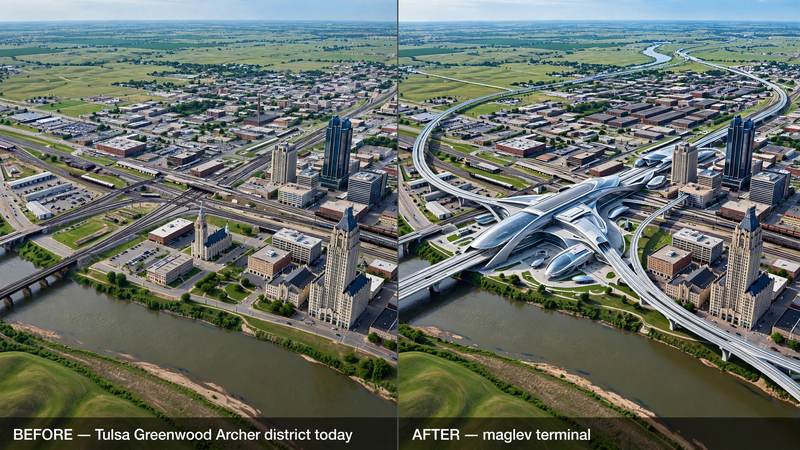
Aerial mock-up (illustrative, not an engineering rendering). Left: the proposed site today. Right: with the maglev terminal.
- East Tulsa (Memorial corridor) — eastern commercial district.
- The Broken Arrow Expressway corridor — infill serving southeast growth.
- Indian Springs — south Tulsa retail district.