
Washington, DC
Stop on the proposed 17,000-mile maglev network. Next stop: Baltimore, MD (35.2 mi).
About Washington
Washington, D.C., officially the District of Columbia and commonly shortened to Washington, or DC, is the capital city of the United States, and its only federal district.
Source: Wikipedia summary (full article). Population and facts as published there.
Cost breakdown (proposal-scale estimates — see math)
| Item | Basis | Estimate |
|---|---|---|
| Terminal construction | Major hub terminal — top-10 US metro ($4–8B range) | $6B |
| Land acquisition | Regional factor 1.5× on $200M base | $300M |
| Track: Washington → Baltimore | 35.2 mi × $500M/mi | $17.6B |
| Annual operations (share) | Staffing, power, maintenance | $120M/yr |
| Stop total (excl. annual ops) | $23.9B |
Best terminal location (proposed)
the Union Station district. The corridor's southern anchor already unites Amtrak, Metro, MARC and VRE. The Burnham Place air-rights plan shows how the terminal can grow over the tracks. It captures the capital region — federal workers, tourists and the densest job core between Boston and Richmond.
Before / after
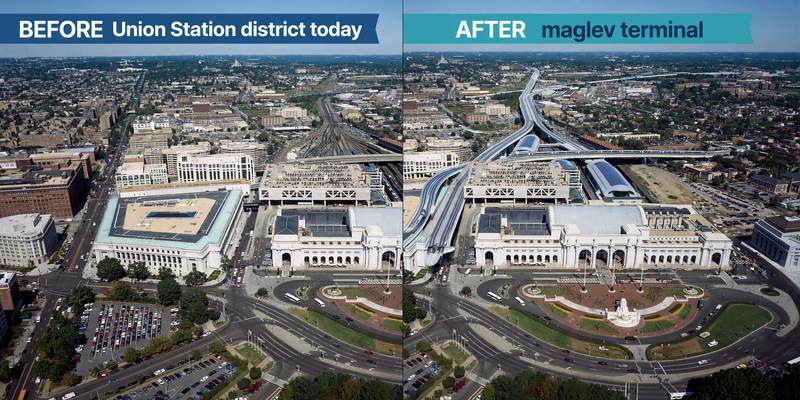
Aerial mock-up (illustrative, not an engineering rendering). Left: the proposed site today. Right: with the maglev terminal.
- Greenbelt — Metro-served city on the B-W Parkway corridor.
- Laurel — city midway between the two terminals.
- BWI district — airport and rail hub at the Baltimore approach.