
Northeast Corridor
Waterbury, CT
Stop on the proposed 17,000-mile maglev network. Next stop: Hartford, CT (23.6 mi).
About Waterbury
Waterbury is a city in the U.S. state of Connecticut. Waterbury had a population of 114,403 as of the 2020 Census.
Source: Wikipedia summary (full article). Population and facts as published there.
Cost breakdown (proposal-scale estimates — see math)
⚠️ All figures below are parametric estimates scaled from the proposal's own budget ($8.5T ÷ 17,000 mi ≈ $500M per mile), not engineering quotes. Methodology is shown so you can check the math.
| Item | Basis | Estimate |
|---|---|---|
| Terminal construction | Small-city terminal — under 200K ($0.5–1B range) | $0.75B |
| Land acquisition | Regional factor 1.5× on $200M base | $300M |
| Track: Waterbury → Hartford | 23.6 mi × $500M/mi | $11.8B |
| Annual operations (share) | Staffing, power, maintenance | $15M/yr |
| Stop total (excl. annual ops) | $12.9B |
Best terminal location (proposed)
the downtown Waterbury station district. The existing Metro-North Waterbury Branch terminus gives a rail-ready downtown site. The Brass City's downtown has redevelopment parcels around the station. It anchors the Naugatuck Valley's quarter-million residents.
Before / after
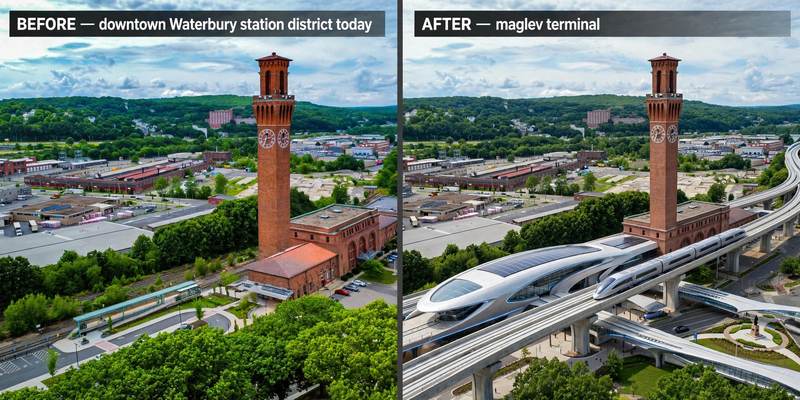
Aerial mock-up (illustrative, not an engineering rendering). Left: the proposed site today. Right: with the maglev terminal.
🛤️ Infill stops toward Hartford: the proposal envisions more stops than cities — smaller stations between majors. Plausible infills on this leg:
← All 287 stops
- Southington — town on I-84 east of Waterbury.
- Bristol — city on the corridor toward Hartford.
- New Britain — city at the Hartford approach.