
Wichita, KS
Stop on the proposed 17,000-mile maglev network. Next stop: Topeka, KS (129.9 mi).
About Wichita
Wichita is the most populous city in the U.S. state of Kansas and the county seat of Sedgwick County. As of the 2020 census, the population of the city was 397,532, and the Wichita metropolitan area had a population of 647,610.
Source: Wikipedia summary (full article). Population and facts as published there.
Cost breakdown (proposal-scale estimates — see math)
| Item | Basis | Estimate |
|---|---|---|
| Terminal construction | Mid-size terminal (parametric range $1-2B) | $1.5B |
| Land acquisition | Regional factor 1× on $200M base | $200M |
| Track: Wichita → Topeka | 129.9 mi × $500M/mi | $64.95B |
| Annual operations (share) | Staffing, power, maintenance | $30M/yr |
| Stop total (excl. annual ops) | $66.65B |
Best terminal location (proposed)
The Old Town district near the former Union Station. Wichita's Old Town warehouses surround the former Union Station with active freight corridors running alongside - ideal elevated-guideway right-of-way. The entertainment district already draws evening crowds, and the aviation industry's workforce gives the terminal a business-traveler base.
Before / after
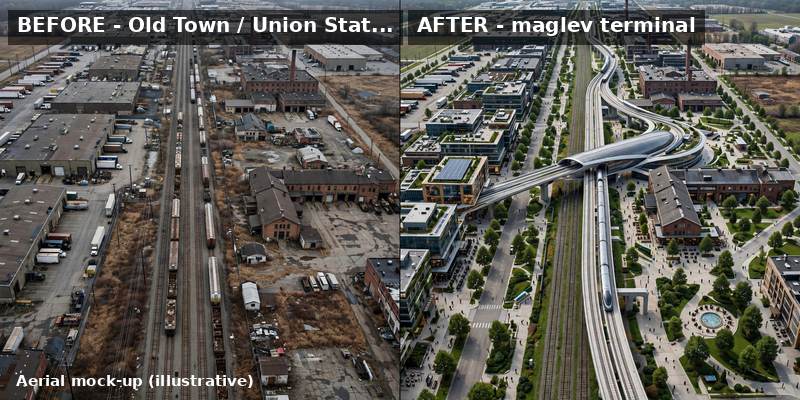
Aerial mock-up (illustrative, not an engineering rendering). Left: the proposed site today. Right: with the maglev terminal.
- Newton, KS - Harvey County rail town on the corridor north
- Emporia, KS - Lyon County city on the Kansas Turnpike
- Osage City, KS - small town on the US-75 corridor south of Topeka